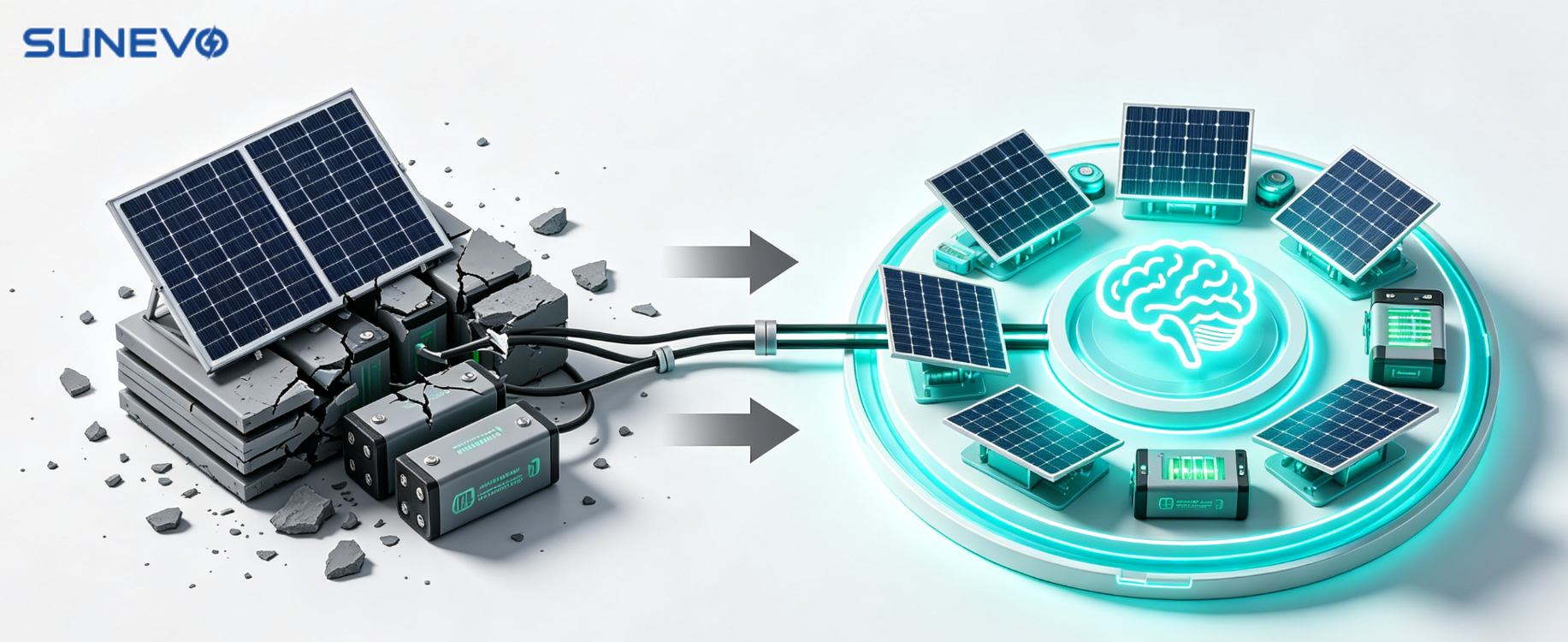
Have you ever noticed a strange contradiction in the renewable energy sector? Solar PV and Battery Energy Storage Systems (BESS) are meant to be the perfect match. Yet, in reality, they often operate like strangers sharing the same bed—disconnected, out of sync, and functioning completely independently.
We see it all the time: a mishmash of multiple brands, incompatible protocols, asynchronous responses, and endless finger-pointing when something goes wrong. It quietly affects your system efficiency, return on investment, and the safety of power station operations.
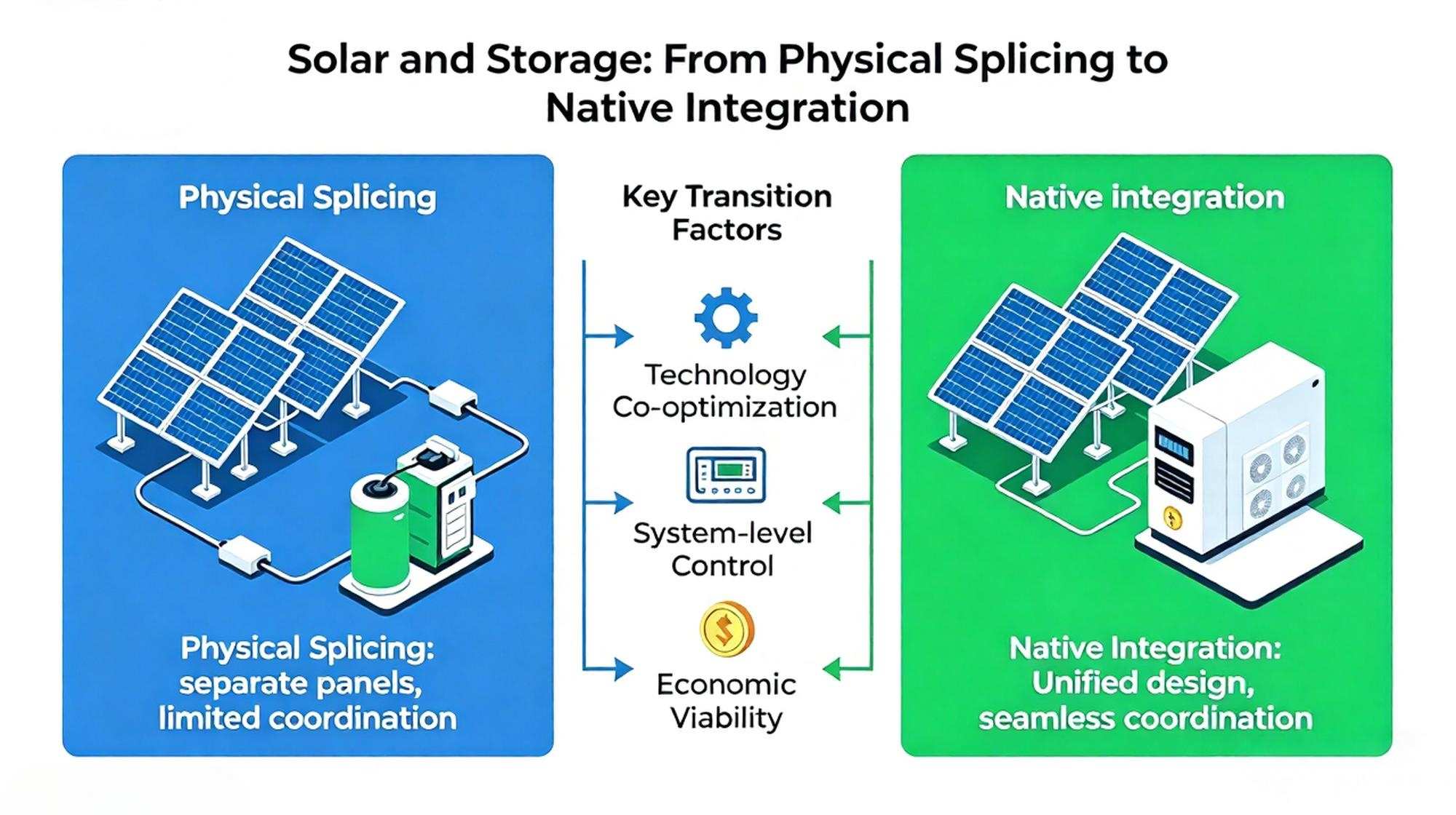
Today, let’s dive deep: How do we transition solar and storage from a mere "physical splicing" to true "native integration"?
I. The Reality: 90% of Projects are Still "Pieced Together"
Let's look at the current industry landscape: roughly 90% of solar + BESS projects are still stuck in the "1+1" pieced-together phase. They look like integrated systems on the outside, but internally, they are running their own separate races.
Why is this happening? The answer is simple. During the explosive growth of the solar and storage market over the past few years, many rushed to meet subsidy deadlines and project schedules by taking the easiest route: using Inverter brand A, PCS brand B, Battery cells from factory C, and an EMS from software company D.
Each component might be a "top-tier" brand on its own, but when forced together, they create a clunky, inefficient "Frankenstein system." This leads to three major pain points of fragmentation:
1. Technical Fragmentation: Compounding Conversion Losses
When the Solar Inverter, PCS, BMS, and EMS come from different manufacturers, every device speaks a different "language." The DC power generated by the solar panels must first be converted to AC by the inverter, then back to DC by the PCS to be stored in the battery, and finally back to AC when discharging.
Every extra conversion step means extra energy loss. Losing 2%-3% at each stage means the overall system efficiency struggles to break 85%. In contrast, a natively integrated system can achieve efficiencies of over 92%. Don't underestimate this 7% difference—for a 100MWh Commercial and Industrial (C&I) storage project, that translates to hundreds of thousands of dollars lost annually.
2. Operational Fragmentation: Out of Sync Strategies
Asynchronous generation and storage strategies are a common disease in pieced-together systems. During peak solar generation, the battery should be charging at full capacity. However, a fragmented EMS often reacts too slowly; by the time the command is executed, solar power is already dropping.
During peak pricing hours, the battery should discharge for arbitrage. But due to inaccurate SOC (State of Charge) estimations, the EMS hesitates to trigger the discharge. The result? Low solar absorption rates and significantly reduced peak-valley arbitrage revenue. It’s only when owners check the balance sheets that they realize the massive gap between theoretical ROI and actual cash flow.
3. Responsibility Fragmentation: The Endless "Blame Game."
This is the ultimate headache for project owners. Imagine your plant suddenly stops charging. You call the inverter manufacturer: "Our output is normal, talk to the PCS guy." You call the PCS supplier: "We received the command, the BMS is refusing to close the breaker." You call the BMS factory: "The batteries are fine, the EMS strategy is wrong." Finally, you call the EMS provider: "We wrote the algorithm based on your specs; it's not our problem."
The project owner is forced to act as a referee. Maintenance costs skyrocket, and troubleshooting is painfully slow. A minor glitch that should take 2 hours to fix ends up dragging on for three days to find the responsible party. Every day the plant is down is hard cash lost.
This is the agonizing reality of a fragmented BESS industry: an illusion of integration hiding a mess of isolated parts.
II. True Integration is Not Just "Adding Things Together"
Some people think that wiring an inverter, a PCS, and a battery cabinet together counts as integration. They are wrong. True integration requires rebuilding the system from the ground up. It must meet three hard standards:
Standard 1: Native Hardware Integration
For new solar projects, this means adopting a DC-coupled architecture. What does this mean? It eliminates redundant combiner boxes and unnecessary AC/DC conversion steps, allowing the DC power generated by the solar panels to connect directly to the battery's DC bus.
When charging is needed, it's a seamless DC-to-DC transfer. When a grid connection is required, a unified inverter handles the conversion. By cutting out an entire layer of transformation, system efficiency instantly jumps. A natively integrated system can outperform a pieced-together system by 5 to 8 percentage points.
Standard 2: A Unified Control Brain (EMS)
This means using a single Energy Management System (EMS) and one cohesive algorithm to achieve millisecond-level synchronization. Solar power forecasting, load forecasting, electricity price forecasting, battery SOC/SOH management, peak shaving strategies, and demand control—all these functions must be integrated into one "brain."
Data doesn't get bottlenecked, and commands don't take detours. Response times shrink from seconds to milliseconds. Only with synchronized responses can an owner's ROI be maximized. A typical C&I solar + storage project with unified control generates 8%-12% more annual revenue than a decentralized one.
Standard 3: Sole Responsibility (Turnkey Provider)
One supplier. Complete accountability. From preliminary design and equipment selection to on-site delivery, grid commissioning, and post-sales O&M—the entire lifecycle is backed by a single company.
No more finger-pointing. If a problem arises, you make one phone call, and they must resolve it. This drastically cuts hidden operational costs. Owners shouldn't have to pay a whole technical team just to manage supplier disputes; they should only have to look at their electricity bills and profit reports.
If a solution lacks even one of these three standards, it is not "native integration."
III. From "Add-ons" to "Symbiosis": Who is Leading the Race?
The inevitable evolution of the solar and storage industry is the shift from "piecing together" to "native integration," from simple "add-ons" to true "symbiosis."
Companies that can provide a true full-scenario, one-stop turnkey solution are no longer just selling equipment; they are selling system stability, guaranteed ROI, and ultimate peace of mind. These are the suppliers that savvy project owners and investors are turning to. Because at the end of the day, owners don't want a pile of branded hardware—they want a high-yield, low-risk, hassle-free power plant.
Think about it: A commercial park installs a 3MW solar + 1MW/2MWh storage system. If they choose a fragmented pieced-together solution, the initial equipment cost might be 10% cheaper. But the money lost annually due to efficiency drops, downtime, and O&M disputes will far exceed that 10% savings.
If they choose a natively integrated solution, they might pay a slight premium upfront, but they will earn 30% more over the system's lifespan. Smart business owners know exactly how to do this math.
What is the most absurd "fragmentation" issue you've ever witnessed in a solar and storage project? Let’s chat in the comments!



 دعم شبكة IPv6

 English
 français
 Deutsch
 italiano
 español
 português
 日本語
日本語 Polski
 ไทย
ไทย