Energy storage has emerged as one of today's hottest topics and industries, and Lithium Iron Phosphate (LiFePO4) batteries have become the core chemistry for energy storage systems due to their high cycle life, longevity, superior stability, and eco-friendly characteristics. Among the various types of LiFePO4 batteries available, the 48V and 51.2V models are frequently compared—particularly in residential and commercial applications. In this article, we will delve into the key differences between these two voltage options and guide you on how to select the right battery to meet your specific needs.
Explaining Battery Voltage
Before we discuss the differences between 48V and 51.2V LiFePO4 batteries, let's first understand what battery voltage is. Voltage is a physical quantity representing electric potential difference; it indicates the magnitude of potential energy. Within a battery, voltage determines the electrical force driving the flow of current. The standard nominal voltage for a single battery cell is typically 3.2V (as is the case with LiFePO4 cells), though other voltage specifications are also available.
Battery voltage is a critical metric in energy storage systems, as it determines the amount of electrical power the battery bank can supply to the system. Furthermore, it influences the compatibility of the LiFePO4 battery with other system components, such as inverters and charge controllers.
In the context of energy storage applications, standard battery voltage designs are conventionally defined as 48V and 51.2V.
What are the Differences Between 48V and 51.2V Lithium Iron Phosphate Batteries?
Different Nominal Voltages:
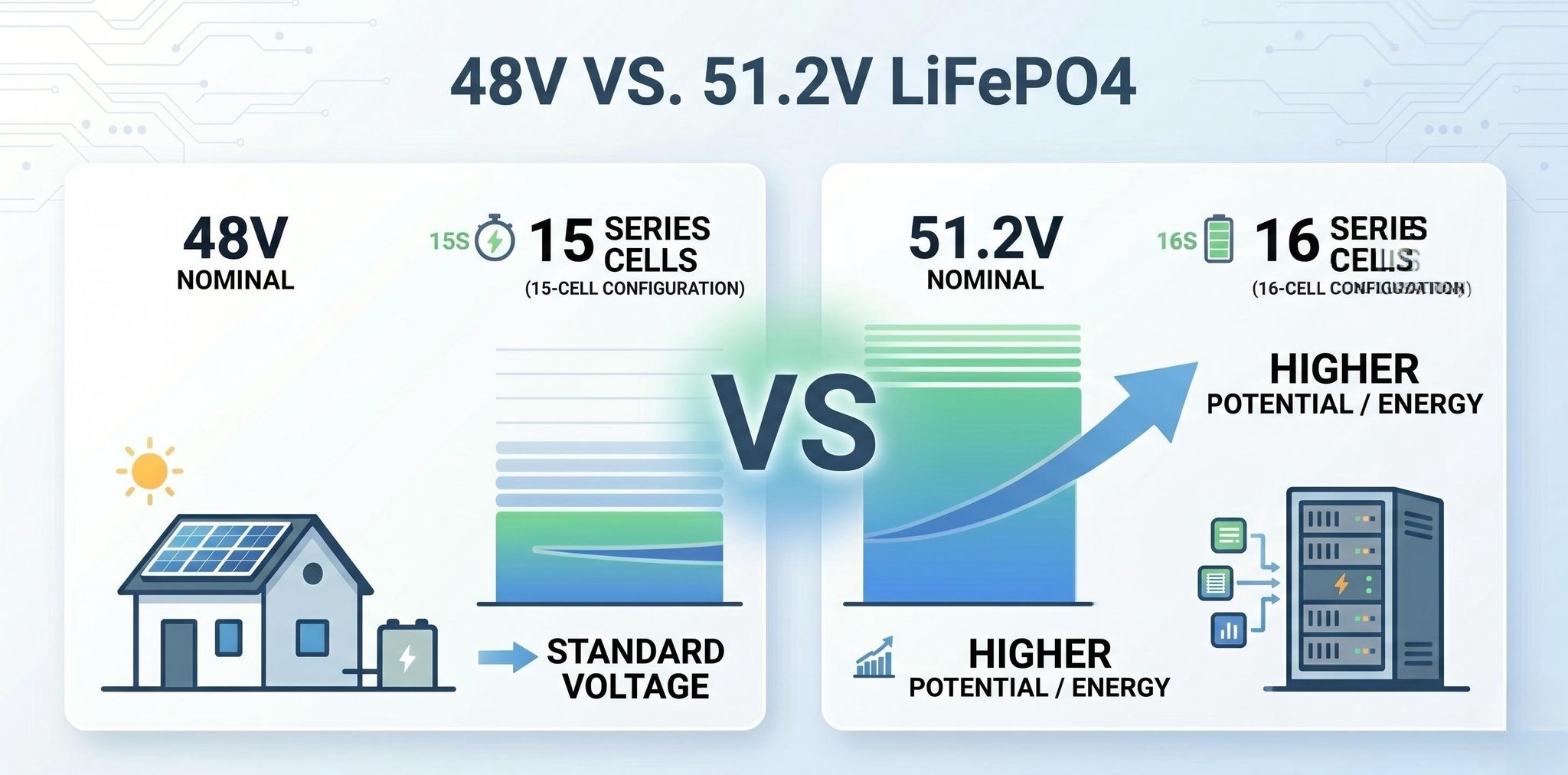
A 48V Lithium Iron Phosphate battery typically has a nominal voltage of 48V, with a charging cut-off voltage ranging from 54V to 54.75V and a discharging cut-off voltage ranging from 40.5V to 42V.
A 51.2V Lithium Iron Phosphate battery typically has a nominal voltage of 51.2V, with a charging cut-off voltage ranging from 57.6V to 58.4V and a discharging cut-off voltage ranging from 43.2V to 44.8V. Difference in Cell Count:
A 48V lithium iron phosphate (LiFePO4) battery typically consists of 15 individual 3.2V LiFePO4 cells configured in a 15-series (15S) arrangement; conversely, a 51.2V LiFePO4 battery is typically composed of 16 individual 3.2V LiFePO4 cells configured in a 16-series (16S) arrangement.
Differences in Application Scenarios:
Even a minor voltage difference can lead to significant distinctions in the selection and application of LiFePO4 batteries, endowing each variant with distinct advantages:
48V LiFePO4 batteries are frequently utilized in off-grid solar systems, small-scale residential energy storage, and backup power solutions. They are often favored due to their widespread availability and compatibility with a broad range of inverters.
51.2V LiFePO4 batteries are gaining increasing popularity in high-performance applications that demand higher voltages and greater efficiency. These applications encompass large-scale energy storage systems, industrial operations, and power sources for electric vehicles (EVs).
However, driven by advancements in LiFePO4 technology and declining costs—and in pursuit of higher efficiency in photovoltaic (PV) systems—off-grid solar setups and small-scale residential energy storage systems are now increasingly transitioning to LiFePO4 batteries utilizing the 51.2V voltage standard.
Comparison of Charging and Discharging Characteristics: 48V vs. 51.2V LiFePO4 Batteries
Voltage differences directly influence a battery's charging and discharging behavior. Therefore, we will compare the 48V and 51.2V LiFePO4 batteries based on three key metrics: charging efficiency, discharge characteristics, and energy output.
1. Charging Efficiency
Charging efficiency refers to a battery's capacity to effectively store energy during the charging process. A battery's voltage has a positive correlation with its charging efficiency; specifically, higher voltage results in higher charging efficiency, as illustrated in the figure below:
A higher voltage implies that a lower current is required to achieve the same charging power output. A reduced current effectively minimizes the heat generated by the battery during operation, thereby reducing energy losses and allowing for the storage of a greater amount of electrical energy within the battery.
Consequently, 51.2V LiFePO4 batteries offer distinct advantages in fast-charging applications. This is precisely why they are better suited for scenarios involving high-capacity or high-frequency charging requirements—such as commercial energy storage systems and electric vehicle charging infrastructure. Comparatively speaking, while the charging efficiency of 48V lithium iron phosphate batteries is slightly lower, it remains at a high level when compared to other electrochemical technologies, such as lead-acid batteries. Consequently, they are well-suited for various other applications, such as home energy storage systems and backup power systems like UPS units.
2. Discharge Characteristics
Discharge characteristics refer to a battery's performance when releasing stored energy to a load; these characteristics directly impact the stability and efficiency of system operation. Discharge characteristics are determined by the battery's discharge curve, the magnitude of the discharge current, and the battery's durability:
Due to their higher voltage, 51.2V lithium iron phosphate batteries are typically capable of discharging stably under higher current loads. This higher voltage implies that the current load borne by each individual cell is lower, thereby mitigating the risks of overheating and over-discharge. This specific characteristic makes 51.2V batteries particularly suitable for applications requiring high power output and prolonged, stable operation—such as commercial energy storage, industrial equipment, or high-power electric tools.
3. Energy Output
Energy output is a metric that quantifies the total amount of energy a battery can deliver to a load or electrical system within a given timeframe; it directly influences the system's available power and operational range. Battery voltage and energy density are the two key factors that determine energy output.
51.2V LiFePO4 batteries offer a higher energy output than their 48V LiFePO4 counterparts. This difference primarily stems from the internal configuration of the battery modules: the 51.2V battery incorporates one additional cell, which translates to a slightly greater energy storage capacity. For example:
48V 100Ah Lithium Iron Phosphate Battery: Storage Capacity = 48V × 100Ah = 4.8 kWh
51.2V 100Ah Lithium Iron Phosphate Battery: Storage Capacity = 51.2V × 100Ah = 5.12 kWh
Although the energy output of a single 51.2V battery unit exceeds that of a 48V unit by only 0.32 kWh, this qualitative difference leads to significant quantitative gains when scaled up: a bank of 10 51.2V batteries will yield 3.2 kWh more energy than a comparable bank of 48V batteries, while a bank of 100 51.2V batteries will yield an additional 32 kWh.
Therefore, assuming an identical current, a higher voltage results in a greater total energy output from the system. This means that a 51.2V battery is capable of delivering greater power output over short durations; it is better suited for extended operation and can satisfy higher energy demands. While a 48V battery offers slightly lower energy output, it remains entirely sufficient to handle typical daily household loads.
System Compatibility
Whether you are choosing a 48V or a 51.2V Lithium Iron Phosphate (LiFePO4) battery, compatibility with the inverter is a critical factor to consider when selecting a complete solar energy system.
Typically, the specifications for inverters and charge controllers will list a specific acceptable battery voltage range. If your system is designed for 48V operation, both 48V and 51.2V batteries will generally function; however, performance may vary depending on how well the battery's specific voltage aligns with the system's requirements.
Most of BSLBATT’s solar batteries operate at 51.2V, yet they remain compatible with virtually all 48V off-grid and hybrid inverters currently available on the market.
Pricing and Cost-Effectiveness
In terms of cost, 51.2V batteries are undeniably more expensive than their 48V counterparts. However, in recent years—driven by a decline in the cost of LiFePO4 raw materials—the price gap between the two has narrowed significantly.
Furthermore, given their superior output efficiency and energy storage capacity, 51.2V batteries typically offer a shorter return-on-investment (ROI) period in the long run.
Future Trends in Battery Technology
Thanks to the unique advantages inherent in LiFePO4 chemistry, both 48V and 51.2V batteries will continue to play a pivotal role in future energy storage solutions—particularly as the demand for both grid-tied renewable energy integration and off-grid power systems continues to grow.
Nevertheless, driven by the increasing demand for more powerful and scalable energy storage solutions, higher-voltage batteries—which offer enhanced efficiency, safety, and energy density—are likely to become increasingly prevalent. As an example, BSLBATT has introduced a comprehensive range of high-voltage batteries (featuring system voltages exceeding 100V) designed for use in both residential and commercial/industrial energy storage applications.
Conclusion
Both 48V and 51.2V LiFePO4 batteries possess their own distinct advantages; the optimal choice ultimately depends on your specific energy requirements, system configuration, and budgetary constraints. However, gaining a preliminary understanding of the differences regarding voltage levels, charging characteristics, and application suitability will empower you to make an informed decision that best aligns with your energy storage needs. If you are still unsure about solar power systems, please contact our sales engineering team; we will provide you with recommendations regarding system configuration and battery voltage selection.
Frequently Asked Questions (FAQ)
1. Can I replace my existing 48V LiFePO4 battery with a 51.2V LiFePO4 battery?
Yes, in certain cases; however, please ensure that your solar system components (such as the inverter and charge controller) are capable of handling the voltage difference.
2. Which battery voltage is more suitable for solar energy storage?
Both 48V and 51.2V batteries are suitable for solar storage; however, if efficiency and rapid charging are your top priorities, a 51.2V battery may offer superior performance.
3. Why is there a distinction between 48V and 51.2V batteries?
The difference stems from the nominal voltage of LiFePO4 batteries. Typically, a battery labeled as "48V" actually has a nominal voltage of 51.2V; however, some manufacturers round this figure down for the sake of simplicity.



 دعم شبكة IPv6

 English
 français
 Deutsch
 italiano
 español
 português
 日本語
日本語 Polski
 ไทย
ไทย